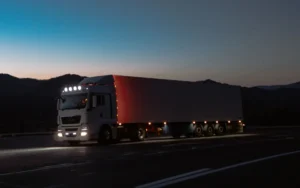
Transport and logistics companies move goods between warehouses, factories and customer sites every day. With many trips and different shipment sizes, knowing the load on each truck and how it is distributed helps you plan transport and review how vehicles are used. A truck axle load sensor is one of the tools that makes this possible.
Load monitoring does not rely on one sensor that fits every truck, though. Suspension types differ, and so do the way load is measured and the equipment needed to show readings on a device or platform. Among the available options are the wireless Eurosens sensors: Eurosens DDS BT for leaf-spring suspension and Eurosens DPS BT for air suspension. This guide explains how they work, the difference between them, why calibration matters and how to use load data in fleet tracking.
محتويات المقال
What Is a Truck Axle Load Sensor?
A truck axle load sensor is part of a system that measures or estimates the load on one of the vehicle’s axles. Some systems use the change in air pressure in the suspension; others track how mechanical suspension parts move under load. After installation and calibration, the readings become data that can estimate axle load or, with the right setup, the weight of the cargo.
It is important to separate three things: the load on one axle, the gross weight of the loaded vehicle, and the weight of the cargo alone. Which one you get depends on the system design, the number of measuring points and the calibration method.
Why Monitor Truck Load?
- Axle load review: see an estimate of the load on an axle or axle group and check distribution against the vehicle’s capacity.
- Weight changes over time: when readings are logged with time and location, you can review changes in the context of each trip. A weight change alone does not prove where goods were loaded or unloaded.
- Loading checks: readings can support the review of loading operations when the system reports during them.
- Threshold alerts: with calibrated readings, the platform can alert you when a set limit is exceeded.
- Fleet reports: load data adds context to transport and utilization reports.
Eurosens DDS BT: For Leaf-Spring Suspension
Eurosens DDS BT is an axle load sensor designed for vehicles with leaf-spring suspension. The sensor is mounted on the vehicle frame with a vertical rod connected to the axle, so suspension movement under load turns the sensor’s lever. The sensor converts that movement into a digital reading that is proportional to the axle load and sends it wirelessly over Bluetooth to a compatible receiver or tracker.
Because it is wireless and battery-powered, installation needs no signal cable between the sensor and the tracker. Battery life, ingress protection and operating temperature are listed in the manufacturer’s datasheet; confirm them for your configuration before you buy, as real results depend on installation and operating conditions.
Eurosens DPS BT: For Air Suspension
Eurosens DPS BT is an axle load sensor designed for vehicles with air (pneumatic) suspension. Instead of following lever movement, it monitors pressure changes in the air-suspension elements and sends the data over Bluetooth to a compatible monitoring device. The readings are then converted into an axle load estimate according to the system’s calibration.
DDS BT or DPS BT: Which One Fits Your Truck?
The main difference between these two axle load sensor models is the suspension type each one is built for and the way it senses load: DDS BT for leaf springs, DPS BT for air suspension. Do not choose by name or appearance; confirm the suspension on each truck, your measuring needs and compatibility with your existing tracker first.
Why Calibration Matters
A truck axle load sensor does not turn every signal into an accurate weight on its own. With DDS BT the reading follows suspension movement, and with DPS BT it follows air pressure, so the system must be calibrated according to its design and the manufacturer’s instructions. Calibration may require known reference loads and tests under suitable loading conditions. Installation quality, calibration and operating conditions all affect reliability, so verify the readings after installation rather than assuming the system shows an exact weight from day one.
Can a Truck Axle Load Sensor Be Linked to GPS Tracking?
Yes, when the sensor, the tracker or receiver and the platform all support the required connection. The tracker provides location and movement, while the sensor provides the load it can measure or estimate, and the platform can show both together. Bluetooth on the sensor does not mean it works with every GPS device, so check the tracker model, firmware and supported interface before choosing. Eurosens DDS BT is documented to work with compatible Teltonika terminals. To combine load, location and trip data in one view, see our logistics fleet solutions.
Can the Sensor Show Total Cargo Weight?
It depends on the configuration. A single axle load sensor gives data for that axle only. Estimating gross vehicle weight or cargo weight may need readings from several axles and a suitable calculation, and cargo weight also requires knowing the empty weight. If you need total or cargo weight, confirm that the weighing system and its software support it.
Is Onboard Weighing a Replacement for an Official Weighbridge?
Do not assume so. Onboard weighing provides operational data for monitoring loads. Using it for official or regulatory purposes depends on the use case, the competent authority and the system’s certification, so check the local requirements in Saudi Arabia before relying on readings as legal proof of weight.
How to Choose the Right Axle Load Sensor
- Suspension type: leaf spring or air suspension decides between DDS BT and DPS BT.
- Weight you need: one axle, gross weight or cargo weight.
- Tracker compatibility: Bluetooth support and the ability to send readings to your platform.
- Calibration: how it is done and whether known reference weights are needed.
- Installation and conditions: mounting method and suitability for your vehicles and environment.
- Full scope: sensor, receiver or tracker, setup, calibration, platform integration and support.
Frequently Asked Questions
When should I choose DDS BT, and when DPS BT?
DDS BT is for vehicles with leaf-spring suspension, while DPS BT is for vehicles with air suspension. The choice depends on the suspension type and technical compatibility.
Are Eurosens DDS BT and DPS BT wireless?
Yes, both send data over Bluetooth. Receiving and displaying the readings still requires a compatible device or monitoring terminal.
Can the sensor be linked to a GPS tracker?
Yes, if the tracker or receiver and the platform support the interface and data. Do not assume compatibility with every GPS device.
Does the sensor measure the full payload?
It depends on the configuration, the number of monitored axles and the calculation method. Axle load, gross weight and cargo weight are different measurements.
Does the sensor need calibration?
Yes. To estimate weight, every axle load sensor must be calibrated according to the system instructions, and readings should be checked after installation.
Can I use it as official proof of weight?
Do not assume so without checking the system’s certification and the requirements of the competent authority for your purpose.
How Afaq Alrasd Aldhki Can Help
We help transport companies in Saudi Arabia assess load-monitoring needs, choose the right truck axle load sensor for each suspension type, and show load data next to location and trips on Afaq Platform, with installation, calibration support and technical support. Explore our logistics fleet solutions, or request a quote to discuss your trucks.