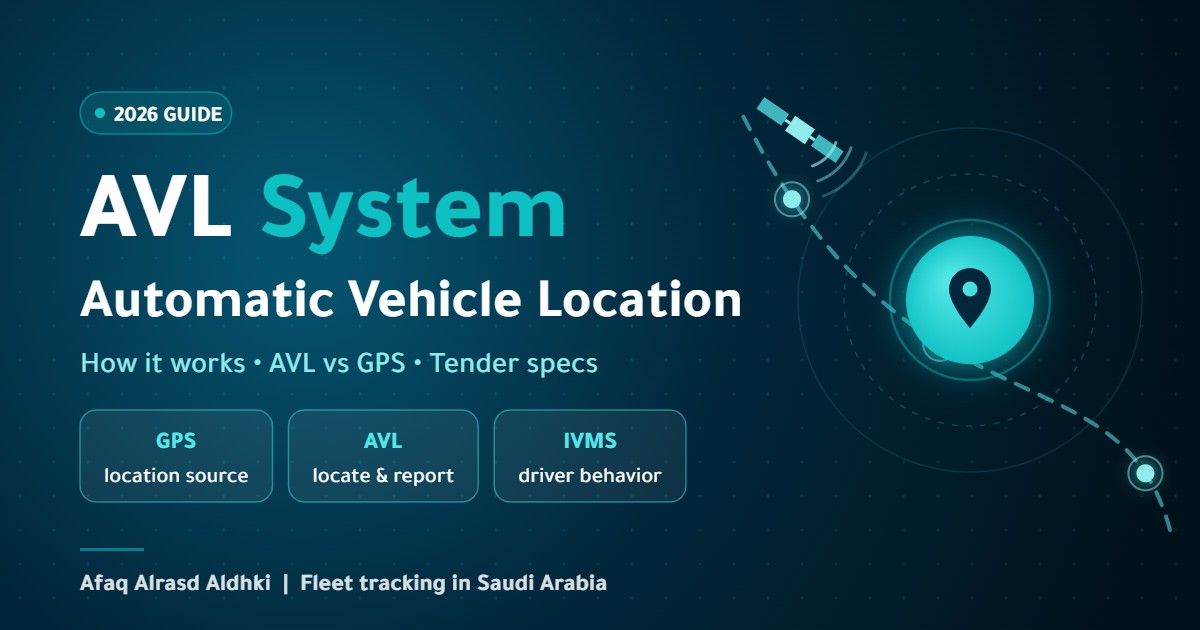
An AVL system is a term you will meet in government tenders, RFQs and tracking proposals across Saudi Arabia, yet many companies are not sure exactly what it means, or whether it is the same as a GPS tracker, an IVMS or fleet management software. This guide explains what automatic vehicle location is, how an AVL system works, how it differs from the terms around it, where it is used in the Kingdom, and gives you a practical checklist for specifying it in a tender or request for quotation.
Table of Contents
What Is an AVL System?
AVL stands for Automatic Vehicle Location. An AVL system determines a vehicle’s position automatically and sends it to a monitoring center without any action from the driver, so a supervisor always knows where each vehicle is, where it has been and what it is doing.
The term AVL is used mostly by government bodies, public transport, emergency services and procurement teams, while the market often calls the same function a “tracking device” or simply “GPS”. So when a tender asks for an AVL system, it usually means a complete tracking solution: an in-vehicle device plus a platform for data, alerts and reports.
How Does an AVL System Work?
An AVL system runs in a continuous loop: the device finds its position, sends it over a network, and the platform processes it and shows it on a map. It has four parts:
- The in-vehicle AVL device: a satellite positioning receiver (GPS and other systems), a communication module, and inputs for sensors and engine status.
- The network: carries data from the vehicle to the server, usually a mobile data SIM, with satellite communication as an option in remote areas.
- The server: receives, stores and analyzes the data and triggers alerts.
- The platform: a web dashboard and mobile app showing vehicle locations, routes, alerts and reports.
An AVL system sends more than location. It also reports speed, heading and ignition status, and can read data from fuel, temperature, weight and door sensors, as well as the vehicle’s CAN Bus network.
AVL vs GPS vs IVMS vs Telematics
These terms overlap a lot in proposals and specifications. This table shows the difference:
| Term | What it means | Main focus |
|---|---|---|
| GPS | Satellite positioning technology | The source of location only; it does not transmit data on its own |
| AVL | Automatically locating a vehicle and sending its position to a monitoring center | Where the vehicle is now, where it has been, and when it moved or stopped |
| IVMS | In-vehicle monitoring of the vehicle and driver | Speed, driving behavior and compliance with safety policies |
| Telematics | The wider field of connected vehicle data | Location, engine data, sensors and video together |
| Fleet management system | Software that uses this data to run operations | Maintenance, costs, jobs and drivers |
In short: GPS is the location source, AVL is the function of locating and reporting, and telematics and fleet management are what you build on top. In practice, most modern systems combine these layers in one platform, often together with driver behavior monitoring.
Core AVL System Features
- Real-time tracking: every vehicle on the map with speed, heading and engine status.
- Trip history: replay the full route of any trip with stops and times.
- Geofencing: virtual zones around warehouses, sites and customers, with entry and exit alerts.
- Alerts: speeding, long stops, idling, power disconnection and movement outside working hours.
- Engine hours: ignition on and off times, which matter more than distance for equipment and generators.
- Reports: daily, weekly and monthly reports on trips, stops, violations and usage.
- Panic button: lets the driver send an instant alert with location to the control room.
- Integration: APIs to connect AVL data with your other business systems.
Where AVL Is Used in Saudi Arabia
- Transport and distribution companies: tracking deliveries, arrival times and job allocation, as part of logistics and fleet solutions.
- Trucks and heavy equipment: location and engine hours, with weight and fuel sensors. See construction and heavy equipment tracking.
- Public transport and school buses: public transport relies on AVL to monitor schedule adherence and give passengers arrival times; one example in the Kingdom is the automatic vehicle location system selected for the AlUla tramway. For schools, see school bus tracking.
- Ambulance, security and civil defense: knowing where every unit is so the nearest one can be dispatched.
- Government vehicles and rental companies: controlling out-of-hours use and protecting vehicles against theft.
AVL with CAD: Dispatching the Nearest Vehicle
In control rooms, an AVL system is usually connected to computer-aided dispatch (CAD) software. When a call comes in, CAD shows the nearest available vehicle based on live AVL data, which shortens response times and lets each dispatcher manage more vehicles. The same idea helps field maintenance teams, security patrols, recovery trucks and delivery services, not just emergency services.
How to Specify an AVL System in a Tender or RFQ
A general request such as “supply an AVL system” makes proposals hard to compare. Define these points clearly to get like-for-like offers:
- Supported positioning systems: GPS plus others such as GLONASS and BeiDou for better accuracy, and how the device behaves in remote areas.
- Reporting interval: and whether it can be set differently while moving and while parked.
- Offline storage: the AVL device should store data when coverage drops and resend it automatically when the connection returns.
- Backup battery: with an instant alert if the device is disconnected from vehicle power.
- Inputs and outputs: for fuel, temperature, weight and door sensors, CAN Bus data, and remote engine immobilization under safe conditions.
- Platform and reports: user permissions, required reports, data retention period and Arabic language support.
- Integration: APIs for your systems such as ERP, and the ability to connect to official platforms where your activity requires it.
- Data security and hosting: where data is hosted, encryption and backups.
- Installation and support: in-Kingdom installation, warranty, technical support and supervisor training.
- Pilot: run the system on a small group of vehicles before rolling it out to the whole fleet.
AVL System FAQ
What does AVL stand for?
AVL stands for Automatic Vehicle Location: a system that determines a vehicle’s position and sends it automatically to a monitoring center.
What is the difference between AVL and GPS?
GPS is only the positioning technology. An AVL system uses GPS, then sends the location and other data to a platform that displays it, stores it and raises alerts. In other words, GPS is one part of an AVL system.
Does an AVL system work without internet?
The device finds its position from satellites without internet, but it needs a network to send data. Good devices store data when coverage drops and send it when the network returns, and satellite communication can be used in remote areas.
What is the difference between AVL and IVMS?
AVL focuses on where the vehicle is and how it moves, while IVMS focuses on the driver, driving behavior and safety compliance. Many modern systems combine both in one device and platform.
Can an AVL device be fitted to heavy equipment and generators?
Yes. AVL is used on mobile assets such as construction equipment and generators, where engine hours usually matter more than distance traveled.
Is an AVL system the same as fleet tracking?
For most companies, yes: AVL fleet tracking is the formal name for knowing where your vehicles are in real time. Fleet management software then builds on that data for maintenance, costs and jobs.
How Afaq Can Help
Afaq Alrasd Aldhki provides complete AVL systems: tracking devices and sensors installed in the Kingdom, an Arabic and English platform for live tracking, reports and alerts, integration with your systems, and training for your team. Explore smart GPS road monitoring or request a quote for your fleet.