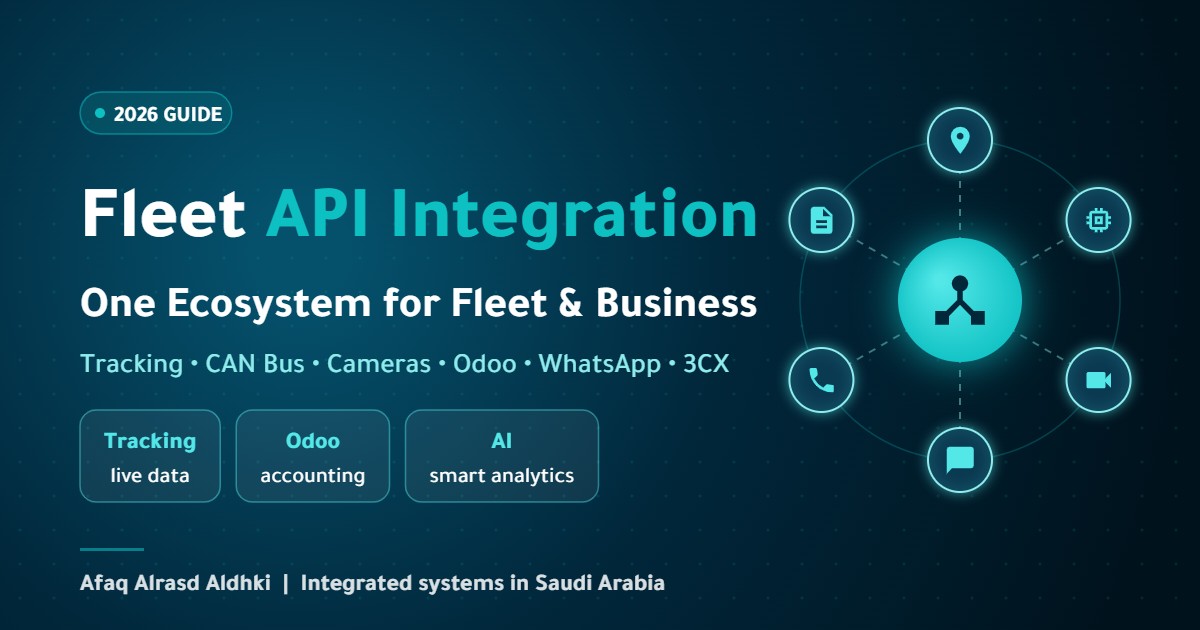
Fleet management API integration is what turns a collection of separate software into one system that works together. In many Saudi companies, the tracking platform runs on its own, the camera platform on its own, accounting in Odoo on its own, and the call center and WhatsApp messages somewhere else, so staff enter the same data more than once and decisions arrive late. This guide explains how these systems connect: tracking and CAN Bus data, AI cameras, the accounting system, WhatsApp, the 3CX phone system and AI, with practical scenarios and a phased implementation plan.
Table of Contents
The Data Island Problem: Why Integrate Your Systems?
- Double entry: odometer readings typed by hand into the maintenance system, violations copied by hand into the driver file.
- Slow response: a fuel theft alert sits in a platform the manager only opens at the end of the day.
- Weak customer service: the call center agent does not know where the customer’s shipment is while the customer is on the line.
- Conflicting numbers: operations and finance work from different data.
Fleet management API integration solves these problems because each piece of information is recorded once at its source and then flows automatically to every system that needs it.
What Is an API, Simply Put?
An application programming interface (API) is a structured way for two systems to exchange data and commands without human involvement. There are two basic patterns in fleet management API integration:
- Instant notification (webhook): the source system sends an event the moment it happens, such as fuel theft or an accident, which suits urgent alerts.
- Scheduled sync: the target system pulls summaries at intervals, such as daily distance and engine hours, which suits accounting data and reports.
The Integrated Ecosystem Map: Where Data Comes From and Where It Goes
| Source | Data | Destination and use |
|---|---|---|
| Tracking and CAN Bus | Distance, engine hours and fuel | Odoo: maintenance, vehicle cost and billing |
| AI cameras (ADAS and DMS) | Safety events and video clips | Monitoring platform, driver record and supervisor alert |
| Tracking alerts | Geofence, speeding and fuel theft | WhatsApp to managers and tasks in Odoo |
| Vehicle location and arrival | Estimated time of arrival (ETA) | WhatsApp message to the customer |
| 3CX phone system | Calls and recordings | Customer card and call log in Odoo |
| AI | Call summaries, driver scoring and anomaly detection | Management reports and improvement decisions |
| Odoo | Invoices | ZATCA’s Fatoora platform |
1. Connect GPS Tracking With ERP and Accounting
Trackers read real distance, engine hours and fuel level from the vehicle network, and their summaries flow to Odoo to update vehicle odometers, schedule maintenance and calculate cost per kilometer. Details are in our Odoo GPS tracking integration and Teltonika CAN bus guides.
2. AI Cameras in the Ecosystem
AI cameras detect events such as tailgating, phone use and fatigue, and send the event with a short clip to the monitoring platform. Once integrated, the event goes to the driver’s record and an instant alert reaches the supervisor, instead of the clip sitting in a platform no one reviews. This is where AI in fleet management delivers real value. Learn more about video telematics and driver safety.
3. WhatsApp Fleet Alerts
Through the WhatsApp Business Platform, you can send important alerts to managers and arrival notifications to customers using approved message templates. The key to useful WhatsApp fleet alerts is to choose the events that truly deserve a message and to get customers’ consent before messaging them, so messages do not turn into noise everyone ignores.
4. 3CX Odoo Integration and the Call Center
With a 3CX Odoo integration, the customer’s card pops up for the call center agent the moment the call arrives, the call is logged on the customer record automatically, and agents can click to dial from inside Odoo. Add tracking data and the agent can see the status of the customer’s vehicle or shipment while on the line. 3CX also brings WhatsApp and live chat into one interface. See our 3CX business phone system page.
5. AI in Fleet Management
- In the vehicle: ADAS warnings and DMS driver monitoring run inside the camera itself.
- In the call center: 3CX offers call transcription, summaries and sentiment analysis, depending on the license.
- In analytics: driver scoring, detection of abnormal fuel patterns and predictive maintenance from CAN Bus data.
Practical Scenarios for an Integrated Ecosystem
Fuel Theft at Night
The fuel sensor or CAN Bus data detects a sudden drop in the tank while the engine is off. The system sends an instant notification, the manager receives the vehicle’s location and event time through WhatsApp fleet alerts, and an incident record is opened in Odoo with the value of the lost fuel. See fuel monitoring.
A Customer Asks About a Shipment
The customer calls, their card appears from Odoo with the vehicle’s last location and estimated arrival, the agent answers within seconds and sends a tracking link on WhatsApp, and the call and its summary are logged on the customer record.
A Fatigued Driver on the Road
The DMS camera detects signs of fatigue, the alert and clip reach the control room, the supervisor contacts the driver immediately, and the event is added to the driver’s file for the training program.
Mileage-Based Maintenance
The odometer reading from CAN Bus reaches the set threshold, a maintenance request is created in Odoo automatically, and a message goes to the workshop to book the appointment.
Integration Approaches
- Ready-made connector: integration modules between two well-known systems; the fastest option but limited to what they were built for.
- Direct API and webhook integration: full flexibility for your specific needs, with development and maintenance required.
- Middleware integration layer: a service that connects all systems in one place and manages sync, alerts and logs; the best fit when there are many systems.
Security and Data Protection
- Limited keys and permissions: each integration gets only the access it needs.
- Encrypted transport and an activity log: to know what moved and when, and catch errors quickly.
- Personal data protection: driver data and recordings are personal data under the PDPL. See dash cam rules and privacy.
- Customer consent on WhatsApp: before sending them any notifications.
A Phased Implementation Plan
- Phase one: connect tracking and CAN Bus to Odoo for distance, maintenance and costs.
- Phase two: important alerts on WhatsApp for managers, then customer notifications.
- Phase three: connect 3CX with Odoo and tracking data in the call center.
- Phase four: AI analytics on the accumulated data.
In fleet management API integration, starting with one phase and measuring its impact beats trying to connect everything at once.
Common Mistakes
- Flooding managers with alerts: they stop reading them; send only the events that matter.
- No clear data owner: so no one knows which system is the source of truth when values differ.
- Not monitoring integrations: a connection stops silently and nobody notices.
- Several vendors without coordination: each blames the other when something breaks.
Frequently Asked Questions
What is fleet management API integration?
It means making fleet and business systems exchange data automatically through APIs, so information is recorded once at its source and reaches every system that needs it without manual entry.
Can WhatsApp be connected to a tracking system?
Yes. Through the WhatsApp Business Platform, alerts and arrival notifications can be sent using approved message templates, with recipients’ consent.
Can 3CX be integrated with Odoo?
Yes. The integration shows the customer’s card on incoming calls, logs calls on the customer record and allows click-to-dial from inside Odoo.
What role does AI play in fleet management?
It works in cameras to detect road risks and driver state, in the call center to summarize calls, and in analytics to score drivers, spot waste and predict maintenance.
Do we need to replace our current systems?
Usually not. Connecting existing systems is faster and less risky than replacing them, as long as they offer APIs or suitable export options.
Where should we start?
Start with the connection that delivers the most value for the least effort, usually to connect GPS tracking with ERP and accounting, then add alerts and communications in phases.
How Afaq Can Help
Afaq Alrasd Aldhki provides every part of the ecosystem under one roof: tracking systems and CAN Bus reading, AI fleet cameras, Odoo solutions and the 3CX phone system with WhatsApp, and we handle the fleet management API integration between them with one party responsible for the whole integration. Request a quote for your integrated ecosystem.